
|
Syntax |
|
||||||||||||||||||||||||||||
|---|---|---|---|---|---|---|---|---|---|---|---|---|---|---|---|---|---|---|---|---|---|---|---|---|---|---|---|---|---|
|
Semantics |
The operation takes any object ( By default the following mapping rules apply:
These default rules can be overridden by using <<XMLElement>>, <<XMLAttribute>> and <<XMLCharacters>> stereotypes on UML class attributes and UML association ends.
A conversion with operation |
||||||||||||||||||||||||||||
|
Substitutables |
|
Target object, can be any complex object. However, simple types and arrays are not supported, since they do not map naturally to a well formed XML document. |
|||||||||||||||||||||||||||
|
|
This optional parameter is an object of type XMLComposeOptions. 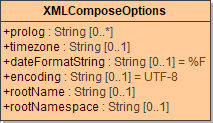
Its attributes are:
|
||||||||||||||||||||||||||||
|
Examples |
|
||||||||||||||||||||||||||||
Example File (Builder project E2E Action Language/XML): XML.zip
<your example path>\E2E Action Language\XML\uml\xmlSimpleConversions.xml
<your example path>\E2E Action Language\XML\uml\xmlComplexConversions.xml
The following action script serializes an object of type Address, provided that you have defined an input object node named myAddress of type Address in the activity diagram.
set xmlBlob = myAddress.classToXMLFragment();
The sample XML fragment below illustrates the mapping executed by classToXMLFragment(). The object myAddress of type Address (see class diagram) is mapped the depicted XML fragment:
   <street>Lautengartenstr. 12</street>
   <city>Basel</city>